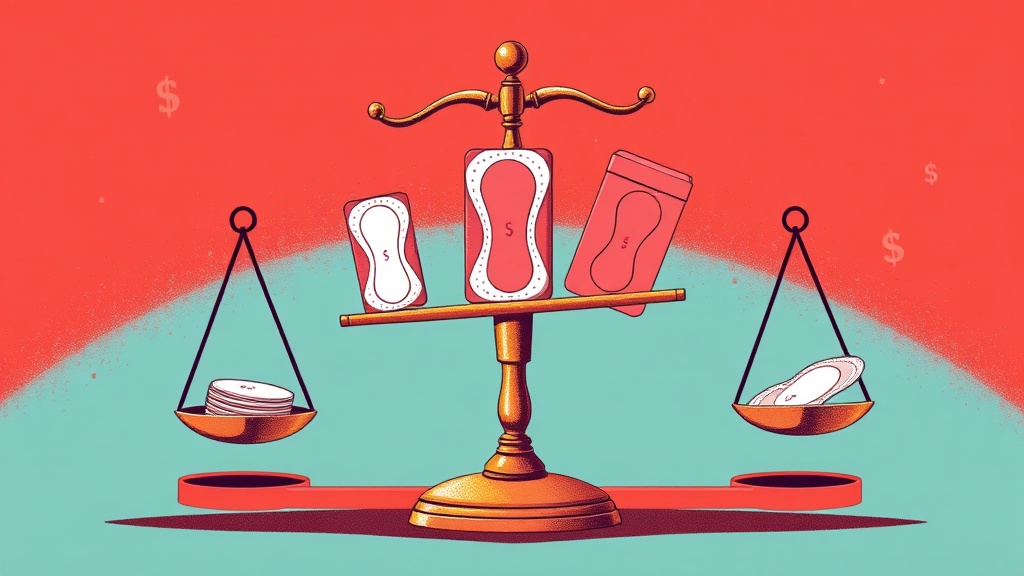
18 States Still Tax Your Tampons Like a Luxury. Here's the Period Poverty Math.

Somewhere in America right now, a teenager is stuffing toilet paper into her underwear because she can't afford a box of pads. And in at least 18 states, that box of pads is taxed like a luxury item — right alongside electronics and jewelry — while Viagra, Rogaine, and dandruff shampoo get medical exemptions.
Let that marinate for a second.
Period poverty — the inability to access menstrual products due to cost — affects roughly 500 million people worldwide and an estimated one in four menstruating people in the U.S. at some point. It's not a niche concern. It's not a "women's issue" that exists in some separate policy silo from healthcare or education or economic justice. It IS those things. And the math is brutally simple.
The Numbers That Should Make You Angry
The average menstruating person spends between $6,000 and $18,000 on period products over their lifetime. That's not counting the pain meds, the heating pads, the ruined underwear, the missed work. Just the products themselves.
Now layer on the tampon tax. As of 2025, 18 states still charge standard sales tax on menstrual products — rates ranging from 4% to 7%. Tennessee, Indiana, and Mississippi (shocking no one) lead the pack at 7%. These are states where low-income residents are already stretched impossibly thin, and we're asking them to pay a premium for something their bodies literally require them to use.
Meanwhile, if you need Viagra? Tax-exempt in most states. Chapstick? Tax-exempt in some. Adult diapers often get exemptions too. The message is: your body's needs are only a medical necessity when a dude experiences them.
The Menstrual Equity for All Act — and Why It's Stuck
There IS a federal bill. The Menstrual Equity for All Act of 2025 (H.R. 3644) was introduced with bipartisan sponsorship — yes, bipartisan, by Congressman Michael Lawler (R-NY) and Congresswoman Sarah McBride (D-DE). The bill would eliminate federal tax on menstrual products, require them in federal buildings, shelters, and schools, and make them eligible under Medicaid and TANF.
It is, on paper, incredibly reasonable. It has bipartisan sponsors. It has public support — polls consistently show 60-70% of Americans support eliminating the tampon tax. And it is going absolutely nowhere in the current Congress because that's what happens to legislation that primarily benefits people who menstruate.
So the real action, as usual, is happening at the state level.
The States That Actually Did Something
Over the past decade, roughly 30 states have eliminated or reduced their tampon tax. Some highlights:
- New York was an early mover in 2016, eliminating the tax after a lawsuit argued it was unconstitutional sex-based discrimination. (It was.)
- California suspended the tax in 2020, made it permanent in 2023.
- Colorado voters approved a ballot measure exempting menstrual products AND diapers from sales tax.
- Alabama — yes, Alabama — passed a temporary exemption running from September 2025 through August 2028. Credit where it's due, even when it comes with an expiration date.
But here's the pattern that should concern you: most of these wins required years of organizing, multiple failed bills, and in some cases, literal lawsuits. The default position of most legislatures is inertia. Products that half the population needs monthly are treated as optional luxuries until someone forces the issue.
Schools Are the Frontline
Where period poverty hits hardest is in schools. Studies show that nearly one in five American teens have missed school because they couldn't access menstrual products. One in five. Think about what that means for grades, for college applications, for the long-term economic trajectories of young people who are already more likely to be low-income.
Several states have passed laws requiring free menstrual products in school bathrooms — California, New York, Illinois, Virginia, and others. But implementation is wildly inconsistent. I've heard from teachers who buy supplies out of their own pockets because the district's "compliance" is a single dispenser in the nurse's office that's empty half the time.
If you're a parent or educator reading this: check what your district is actually doing, not what the policy says on paper. There's usually a gap.
What You Can Actually Do
I'm not going to tell you to "raise awareness." You're aware. You're reading this. Here's what moves the needle:
- Check your state. The Alliance for Period Supplies maintains a state-by-state tracker of tampon tax status and pending legislation. Find out where your state stands.
- Contact your state legislators. Not Congress — your state reps. These bills pass at the state level. A five-minute call or email to your state senator moves the needle more than a tweet thread.
- Donate products, not just money. Local period product drives (Alliance for Period Supplies, local mutual aid) put supplies directly in hands. Shelters, food pantries, and school nurses always need them.
- Push your employer. Your office probably stocks toilet paper and hand soap. Menstrual products should be next to them. Bring it up. Make it weird to NOT provide them.
- Vote on it. When candidates talk about "healthcare" and "education," ask them specifically about menstrual equity. Watch how uncomfortable some of them get. That discomfort tells you everything.
The Bigger Picture
Period poverty isn't a standalone issue. It's a symptom of a system that treats biological functions experienced by women and gender-diverse people as afterthoughts in policy design. The same logic that taxes tampons as luxury goods is the logic that treats pregnancy as a "pre-existing condition," childcare as a "personal choice," and paid family leave as a "perk."
Every one of these fights is connected. And every time we win one — even something as seemingly small as eliminating a 5% tax on pads — we chip away at the underlying framework that says certain bodies and their needs don't count as essential.
Eighteen states left to go. Let's do the math on making that zero.